EAReady
Readiness made visible: weekly self-reflection, class insight, and trial exams built from real past papers.
- Status
- Live
- Stack
- Next.js · TypeScript · Cloudflare Workers · Cloudflare D1 · R2 Object Storage · Docker + Caddy
EAReady turns quick weekly student self-reflection into a shared plan for external assessment. Students rate themselves against behaviourally anchored reflection points and get targeted practice drawn from past examination papers published by the QCAA. Teachers see the class gaps hiding behind the averages, and schools keep access simple with managed accounts and class codes. It began as a single Digital Solutions pilot and now spans 28 senior Queensland subjects, with a Trial Exam Builder that assembles print-ready practice papers from real past-paper questions.
How it works
Behaviour-Anchored Reflection
Students rate each reflection point on a 0 to 4 scale with a described behaviour at every level, so ratings stay comparable across a whole cohort instead of being personal scales.
Readiness Separated From Confidence
Readiness is 40% knowledge and 60% application. Confidence is excluded from the score and tracked as its own diagnostic, making over-confidence visible rather than rewarding it.
Teacher Insight Dashboard
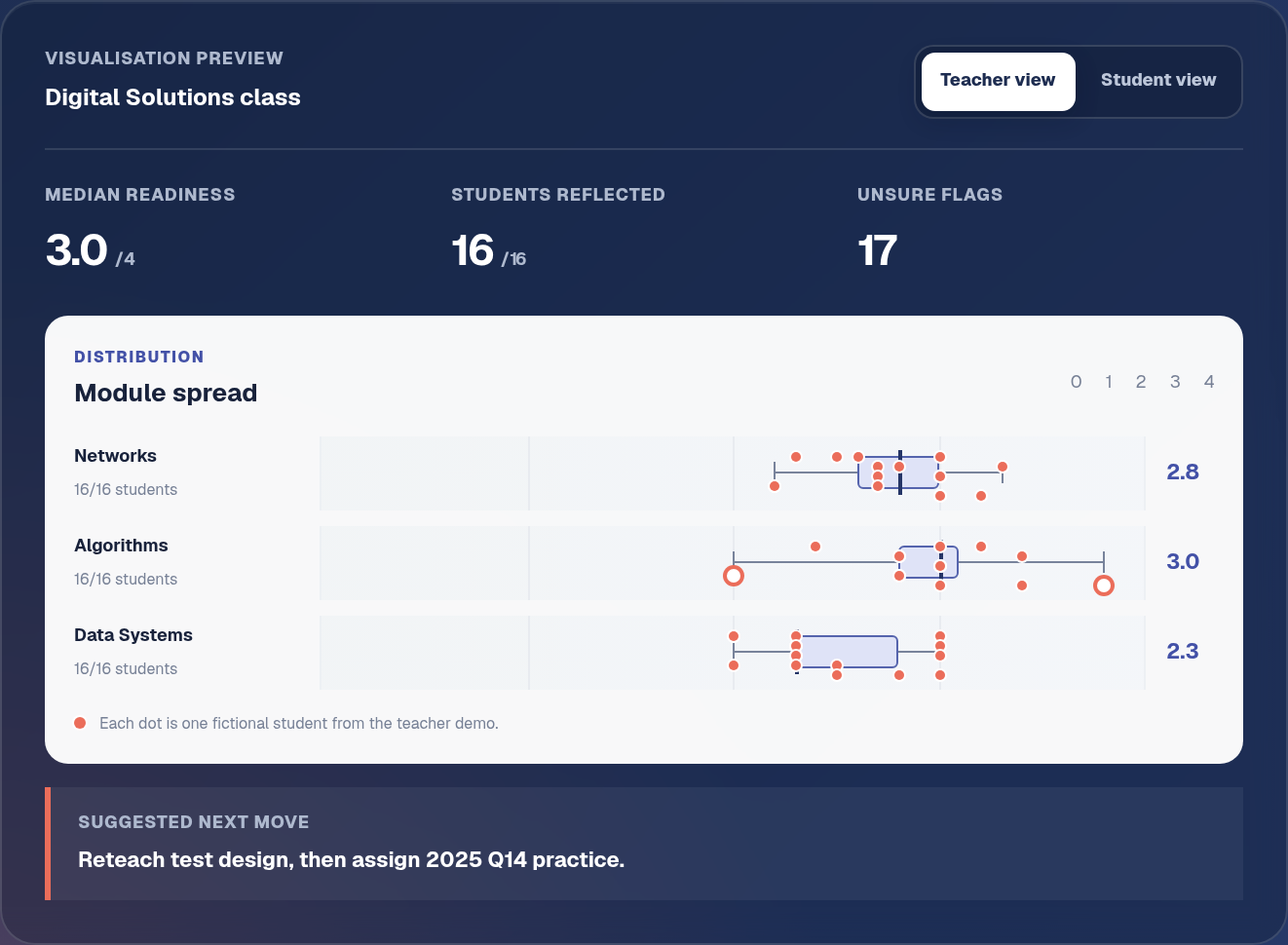
Class medians, response and evidence coverage, confidence distributions, a student-by-content heatmap, calibration signals, and a suggested next teaching move.
Trial Exam Builder
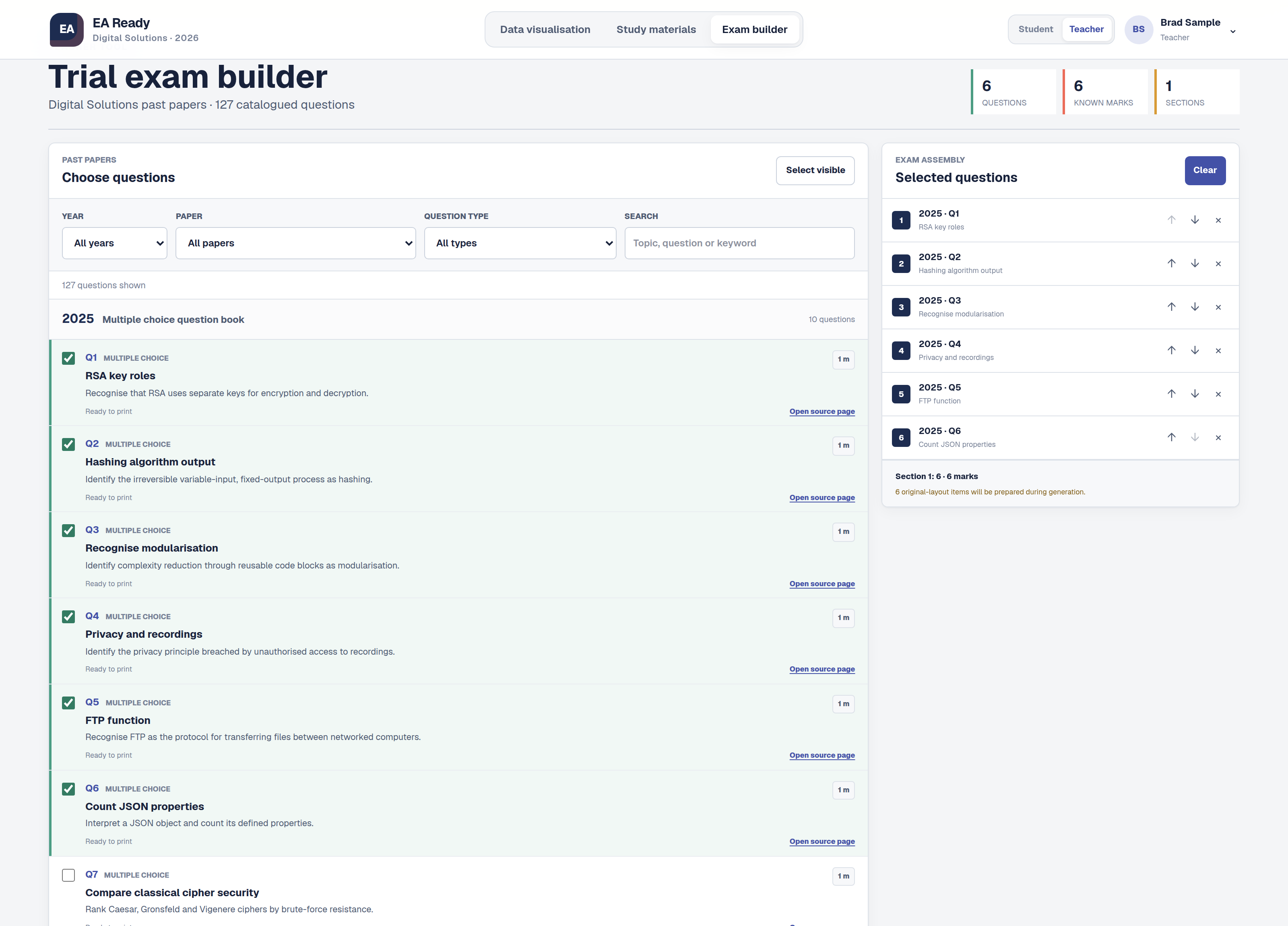
Filter past papers by year, paper and question type, select and reorder questions, edit the cover sheet, and generate a print-ready A4 trial exam rendered from the original QCAA layouts.
Mapped Past-Paper Practice
3,121 catalogued questions across 26 subjects and the 2020 to 2025 papers, mapped to reflection points so practice targets the specific gaps a student has reported.
28 Senior Subjects
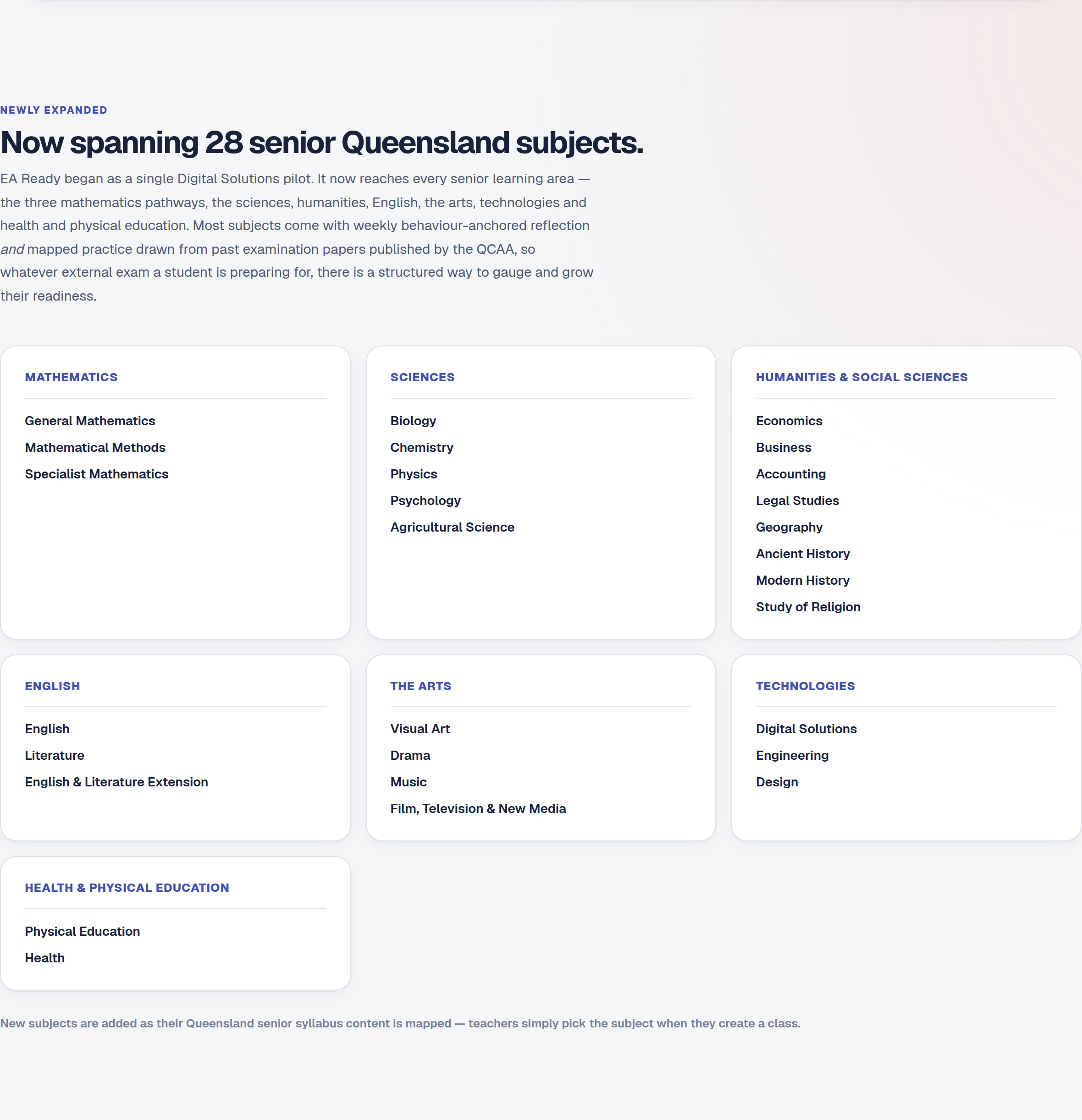
Coverage across every senior Queensland learning area: mathematics pathways, sciences, humanities, English, the arts, technologies, and health and physical education.
School-Managed Access
Four roles (super admin, school admin, teacher, student), class-code enrolment, scoped password resets, and server-side role checks on every route.
Weekly Snapshots
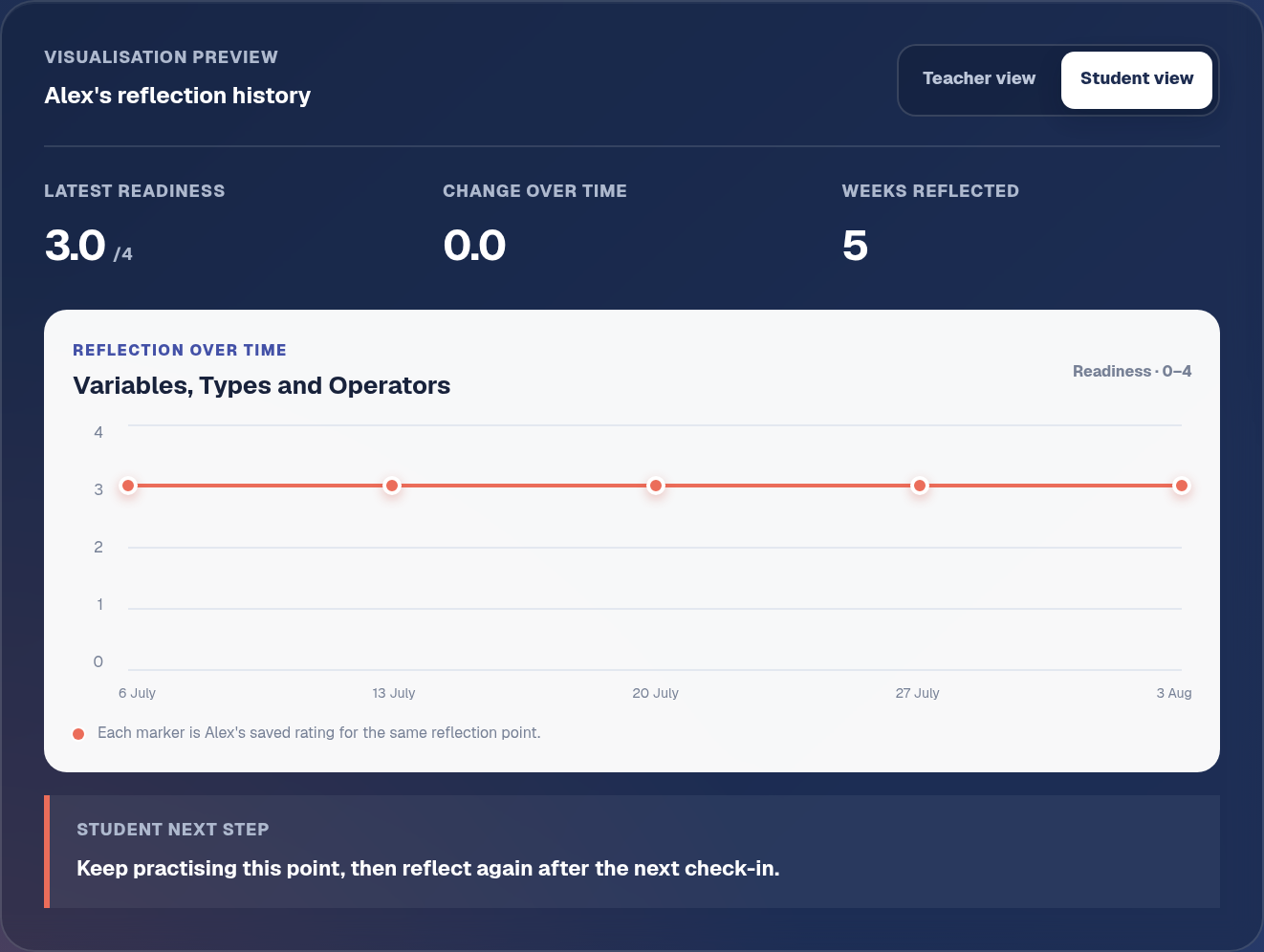
Reflections are stored as dated snapshots so both students and teachers can see change over time rather than only a current state.
What came of it.
- 1Live deployment at eaready.com.au running a full Year 12 cohort across 39 classes and 33 teacher accounts
- 2Coverage expanded from a single Digital Solutions pilot to 28 senior Queensland subjects
- 33,121 past-paper questions catalogued and mapped across 26 subjects and the 2020 to 2025 papers
- 4Trial Exam Builder shipped post-release, removing the manual work of assembling practice papers from past papers by hand
- 5Teachers can identify the specific students and specific content points behind a class average, before the external exam rather than after it
The full story
Senior students are consistently poor judges of their own exam readiness. Most can recall content and will tell you they are fine, right up until they have to apply that content to unfamiliar stimulus under time pressure. EAReady exists to surface that gap weeks before the external exam, in a form both the student and the teacher can act on.
Students rate the visible reflection points for their subject on a behaviourally anchored 0 to 4 scale across three separate signals: knowledge and explanation, application and transfer to unfamiliar stimulus, and confidence under exam conditions. Readiness is calculated as 40% knowledge and 60% application. Confidence is held out of the score entirely and kept as a separate diagnostic, so a confident student who cannot transfer knowledge cannot inflate their own readiness, and the distance between confidence and application becomes a signal of its own.
The teacher dashboard is the other half of the product. It shows class medians per module, response and evidence coverage, confidence distributions, a student-by-content heatmap, calibration signals between confidence and readiness, and a suggested next teaching move. The design goal was that a teacher should be able to open it between lessons and know what to reteach, without doing the interpretation themselves.
Access is built for schools rather than individuals. Super admins create schools and site admins, school admins create classes and manage teacher and student accounts, teachers link to classes and control which reflection modules each class can see, and students join with a class code. Every role check runs server side.
Since release the platform has added a Trial Exam Builder. Teachers filter a catalogue of 3,121 catalogued questions across 26 subjects and the 2020 to 2025 papers, select and reorder individual questions, edit an EAReady cover sheet, and generate a print-ready A4 paper rendered from the original question book layouts so formulas, diagrams and stimulus survive intact.
Screens
Under the hood
- Next.js
- App Router front end and API routes for the student, teacher and admin surfaces
- TypeScript
- Type safety across reflection scoring, role checks, and the past-paper catalogue
- Cloudflare Workers
- Server runtime for the app, self-hosted rather than deployed to the public edge
- Cloudflare D1
- Persistent store for schools, classes, users, reflections, snapshots and audit events
- R2 Object Storage
- Cache of approved official question and stimulus documents used by the trial exam builder
- Docker + Caddy
- Self-hosted deployment and TLS termination on the eaready.com.au domain
Single Next.js application covering student reflection, teacher insight, exam building and school administration, deployed as one container.
Reflection scoring is deterministic and server-side: readiness is derived as 40% knowledge and 60% application, with confidence stored but excluded from the score.
Role resolution happens on the server for every request. Super admin, school admin, teacher and student surfaces are gated by role and scoped by school, and password reset permissions are scoped narrower still.
The past-paper catalogue is a generated artefact mapping questions to subjects, years, papers, question types and reflection points, so practice recommendations and the exam builder read from one source.
The trial exam builder reads only cached, approved source documents. On a cache miss it fails cleanly rather than attempting to retrieve documents from the origin.
D1 state is persisted outside the build output directory so application rebuilds never touch live school data.
- Schools, with unique names, as the tenant boundary for admins, teachers, students and classes
- Classes named by subject, each with a globally unique class code and links to one or more teachers
- Users across four roles with app-owned email and password credentials, forced first-login resets, and session records
- Reflections captured per student, per reflection point, per week, with knowledge, application and confidence ratings plus evidence and next-step notes
- Weekly snapshots so readiness change over time is queryable rather than recomputed
- A generated past-paper catalogue of questions keyed to subject, year, paper, question type and marks
- Audit events recording sign-up, login and administrative actions with the true client IP
- Designing a self-report instrument that resists inflation, solved by anchoring every rating level to a described behaviour and holding confidence out of the readiness score
- Making a class median useful, which required surfacing the full distribution and per-student heatmap rather than the average alone
- Preserving formulas, diagrams and stimulus when assembling questions from multiple past papers into one printable A4 exam
- Scaling from one pilot subject to 28 without invalidating existing reflections or changing the schema
- A launch defect where every reflection save failed silently against a foreign key pointed at a dead legacy table
- Rate limiting that bucketed the whole site under one synthesised IP because the reverse proxy was not forwarding the real client address, turning a per-visitor limit into a site-wide lockout